Europe's life sciences ambitions will be shaped by the talent strategies of biotechnology, pharmaceutical and chemical companies
Scientific innovation, technological acceleration and global competition are transforming talent into one of the most strategic assets within Europe's life sciences ecosystem.

The European life sciences sector stands at a pivotal moment in its development. Across biotechnology, pharmaceuticals, specialty chemicals, advanced therapeutics, artificial intelligence, digital health and precision medicine, Europe is pursuing an ambitious vision aimed at strengthening its position as a global centre of scientific excellence, industrial innovation and economic competitiveness. This ambition is reflected in the European Commission's recently published Life Sciences Strategy, which identifies biotechnology, innovation, advanced technologies and scientific capabilities as essential pillars of Europe's future prosperity and strategic autonomy. According to the Commission, life sciences contribute substantially to the European economy and represent one of the most promising drivers of future growth, innovation and societal progress
(European Commission Life Sciences Strategy).
This strategic vision extends far beyond research laboratories and scientific discoveries. It encompasses Europe's capacity to transform scientific breakthroughs into industrial capabilities, commercial successes, healthcare improvements and sustainable economic growth. The competitiveness of biotechnology companies, pharmaceutical manufacturers and chemical innovators increasingly depends upon their ability to develop, scale and commercialise complex technologies while navigating demanding regulatory environments and rapidly evolving scientific landscapes. Within this context, talent emerges as one of the most decisive factors influencing organizational performance and long-term success.
The importance of this challenge is increasingly recognised by European institutions. The Council of the European Union regularly highlights the role of innovation, advanced industries, research capabilities and strategic competitiveness in strengthening Europe's economic position within a rapidly changing global environment. As scientific and technological progress accelerates, organizations require access to highly specialised expertise capable of transforming scientific opportunities into operational reality. Scientific knowledge, technological literacy, regulatory understanding and leadership capability are becoming increasingly interconnected within the profiles that drive value creation across the life sciences sector. Council of the European Union – Competitiveness Policy.
Simultaneously, the European Parliament has repeatedly emphasised the importance of strengthening Europe's innovation ecosystem, accelerating technological development and securing the capabilities required to support future industrial leadership. Biotechnology, advanced manufacturing, sustainable chemistry, artificial intelligence and health technologies occupy a central place within these discussions because they represent industries expected to contribute significantly to Europe's future competitiveness and resilience. These developments create substantial opportunities for organizations operating within the sector while also introducing new challenges related to skills, expertise and workforce development. European Parliament Research Service.
The resulting environment is characterised by a level of scientific complexity that continues to increase year after year. Artificial intelligence is accelerating drug discovery. Advanced therapies are creating entirely new treatment paradigms. Digital quality systems are transforming compliance activities. Automation and advanced analytics are reshaping manufacturing environments. Sustainability considerations are influencing industrial strategies across the chemical sector. Scientific disciplines that previously evolved independently increasingly converge within integrated operating models that require collaboration between researchers, engineers, quality professionals, regulatory experts, manufacturing specialists and business leaders.
Research conducted by the World Economic Forum suggests that analytical thinking, technological literacy, adaptability, continuous learning and complex problem solving are among the capabilities expected to grow in importance throughout the coming years. These capabilities align closely with the realities emerging across biotechnology, pharmaceutical and chemical organizations, where scientific expertise increasingly intersects with digital transformation, data science and cross-functional decision making. Consequently, the future competitiveness of many organizations will depend not only upon access to scientific knowledge but also upon access to professionals capable of applying that knowledge within increasingly sophisticated environments. World Economic Forum Future of Jobs Report.
For executive leadership teams, this evolution raises an important strategic question. If scientific innovation represents one of Europe's most important economic opportunities, and if scientific talent represents one of the principal drivers of innovation, how can organizations ensure they identify, attract and develop the individuals capable of shaping the next generation of breakthroughs, products and technologies?
The answer begins with a deeper understanding of the relationship between talent and value creation. While discussions surrounding recruitment frequently focus on candidate availability, salary expectations or labour market conditions, a more fundamental challenge is emerging across the life sciences sector. Organizations increasingly compete for expertise capable of creating value within environments that are becoming more specialised, more interdisciplinary and more technologically advanced. The challenge therefore extends beyond workforce acquisition and increasingly concerns the identification of scientific potential, leadership capability and future contribution.
This distinction is becoming increasingly important because the profiles expected to drive the next generation of innovation often combine capabilities that extend across multiple disciplines. Expertise in biology may intersect with artificial intelligence. Experience in quality systems may intersect with digital transformation. Regulatory knowledge may intersect with strategic project leadership. Manufacturing expertise may intersect with data analytics and process optimisation. As these intersections multiply, organizations face a new strategic imperative: understanding how to identify talent capable of creating value within environments that continue to evolve faster than traditional models of talent evaluation.
The implications of this shift are significant for biotechnology, pharmaceutical and chemical companies across Europe. The organizations that successfully align their talent strategies with the future direction of science and technology will be positioned to accelerate innovation, strengthen operational performance and enhance competitive advantage. Those same dynamics are beginning to reshape the very foundations of how scientific talent is identified, assessed and recruited across the life sciences sector.
The pressure on Europe’s industrial base is transforming scientific recruitment into a business-critical capability
The ambition described by the European Commission is emerging at a moment when several strategic sectors are experiencing significant industrial pressure, particularly within the European chemical industry, which remains a fundamental supplier to pharmaceuticals, healthcare, automotive, energy, agriculture, construction and advanced manufacturing. According to Cefic, the European chemical industry still represents approximately €635 billion in turnover and 1.2 million direct jobs, yet Europe’s share of global chemical sales has declined to 13%, while China now accounts for 46% of global sales. This shift illustrates a structural change in global industrial competitiveness, where European companies must simultaneously manage energy costs, regulatory complexity, investment pressure, sustainability transitions and global competition.
This industrial pressure already has visible consequences. Cefic reported in January 2026 that chemical plant closures in Europe have increased sixfold since 2022, reaching a cumulative 37 million tonnes of production capacity, representing around 9% of European production capacity and leading to 20,000 direct job losses. The same report also warns about a slowdown in new investments, which raises concerns regarding the long-term competitiveness and resilience of the European chemical sector. For recruitment, this creates a paradoxical environment: companies may reduce headcount in some activities while intensifying the search for highly specialized profiles capable of supporting transformation, efficiency, digitalization, regulatory compliance, sustainable chemistry and high-value innovation.
Recent restructuring announcements confirm that the sector is undergoing selective repositioning rather than a simple contraction. Dow announced the closure of three upstream chemical plants in Europe and approximately 800 job cuts as part of a strategy focused on reducing exposure to high-cost and energy-intensive operations, while Wacker Chemie announced more than 1,500 job cuts by 2027, citing high energy prices, bureaucracy, weak demand and competition from China. These examples show that industrial transformation affects both employment volume and the type of expertise companies require, because organizations under pressure increasingly need professionals able to improve operational performance, manage complex transitions and contribute to more competitive business models.
For biotechnology, pharmaceutical and chemical companies, the recruitment consequence is clear. The market is becoming more selective, more technical and more strategic. Companies increasingly need fewer generic profiles and more high-impact specialists capable of acting on several dimensions at once, including scientific expertise, regulatory understanding, quality culture, digital literacy, operational discipline and business awareness. In this environment, recruitment errors become more expensive because a poorly defined search, an imprecise candidate assessment or a slow hiring process can delay transformation projects, weaken execution capacity and reduce the organization’s ability to compete in a changing European industrial landscape.
The profiles becoming particularly strategic include:
- Quality Assurance leaders able to strengthen compliance culture while supporting operational efficiency
- Regulatory Affairs and CMC experts able to navigate increasingly complex development and lifecycle environments
- Process development and manufacturing specialists able to improve scalability, robustness and productivity
- Analytical development and QC professionals able to support product quality, method performance and data integrity
- Senior chemists and formulation scientists able to contribute to innovation, sustainability and industrial feasibility
- Digital quality, automation and data-oriented profiles able to connect scientific operations with technological transformation
- Scientific managers able to translate technical complexity into decisions that support growth, resilience and competitiveness
This is where recruitment becomes directly connected to corporate strategy. The companies that will navigate the European life sciences and chemical transition successfully will be those able to identify the scientific professionals who can help them move from pressure to performance, from complexity to execution and from industrial uncertainty to competitive advantage. For recruitment partners, this requires much more than candidate sourcing; it requires market intelligence, scientific understanding and the ability to recognize profiles whose value is measured by contribution, adaptability and impact within the client’s specific environment.
One of the most significant consequences of the transformations currently affecting biotechnology, pharmaceutical and chemical industries concerns the widening gap between the expertise organizations require and the expertise they are able to identify, attract and mobilize at the speed demanded by increasingly competitive markets. While scientific complexity continues to increase and organizations invest heavily in innovation, digitalization, sustainability and operational excellence, many leadership teams report growing difficulty obtaining visibility into the talent capable of supporting these strategic priorities. The challenge extends beyond recruitment volume and increasingly concerns the identification of expertise that combines scientific depth, technological literacy, regulatory understanding, business awareness and the ability to perform within highly interconnected environments.
This phenomenon creates a series of consequences that directly influence organizational performance. Product development programs depend upon highly specialized expertise. Manufacturing excellence depends upon operational knowledge and process understanding. Regulatory success depends upon professionals capable of navigating increasingly complex global frameworks. Quality systems depend upon leaders capable of strengthening compliance while simultaneously supporting efficiency and innovation. As a result, the availability of critical expertise increasingly influences the speed at which organizations execute strategy, commercialize innovation and respond to changing market conditions.
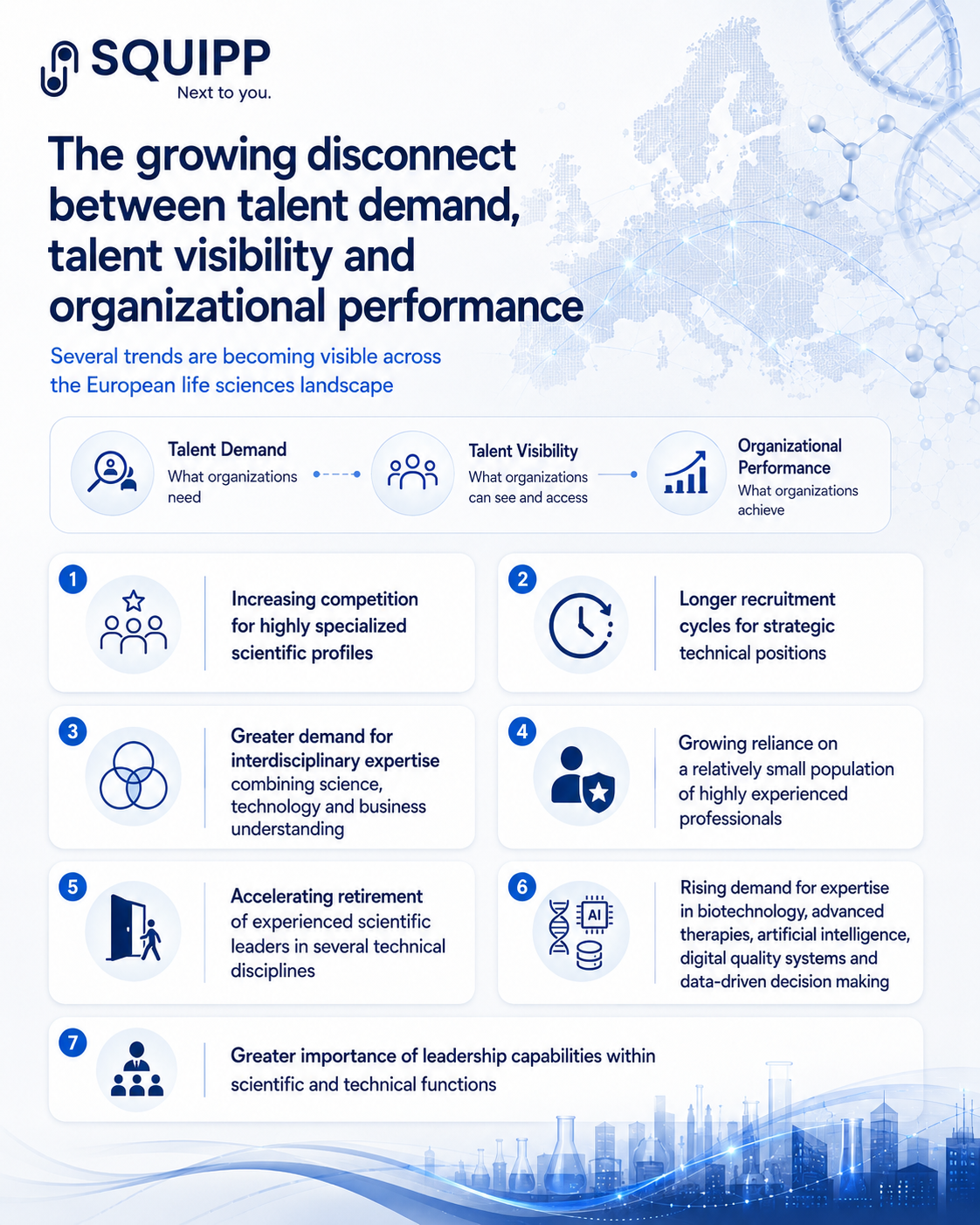
Several trends are becoming visible across the European life sciences landscape:
- Increasing competition for highly specialized scientific profiles
- Longer recruitment cycles for strategic technical positions
- Greater demand for interdisciplinary expertise combining science, technology and business understanding
- Growing reliance on a relatively small population of highly experienced professionals
- Accelerating retirement of experienced scientific leaders in several technical disciplines
- Rising demand for expertise in biotechnology, advanced therapies, artificial intelligence, digital quality systems and data-driven decision making
- Greater importance of leadership capabilities within scientific and technical functions
These developments are occurring simultaneously with profound changes in the composition of the workforce itself. According to the World Economic Forum, technological transformation is reshaping skills requirements across industries, increasing demand for analytical thinking, technology literacy, resilience, adaptability and lifelong learning. Within life sciences, these capabilities increasingly complement traditional scientific expertise and contribute directly to organizational performance. World Economic Forum Future of Jobs Report
The challenge becomes particularly visible when organizations attempt to recruit for positions that sit at the intersection of multiple disciplines. A biotechnology company may require a scientific leader capable of understanding biologics manufacturing, digital technologies, regulatory expectations and cross-functional stakeholder management. A pharmaceutical organization may seek quality professionals able to combine GMP expertise with data integrity, automation and global compliance frameworks. A chemical company investing in sustainability initiatives may require specialists capable of integrating scientific innovation, industrial scalability and environmental objectives. Each of these examples illustrates the same underlying reality: organizational success increasingly depends upon expertise that extends across traditional functional boundaries.
Research from McKinsey highlights a similar trend, emphasizing that life sciences organizations are rethinking talent models in response to scientific and technological disruption. Future competitiveness increasingly depends upon capabilities that enable organizations to adapt, learn and innovate within rapidly evolving environments. Talent therefore becomes more than a workforce consideration; it becomes a strategic asset directly connected to growth, innovation and long-term resilience. McKinsey Life Sciences Insights
For executive teams, the implications are substantial. Scientific expertise remains available within the market, yet its visibility becomes increasingly fragmented as knowledge expands across disciplines, technologies and industries. High-value professionals frequently develop expertise through unconventional career paths, interdisciplinary projects and emerging scientific domains that remain difficult to identify through traditional recruitment criteria alone. Organizations therefore face a new strategic challenge: recognizing future contributors before their value becomes fully visible to the broader market.
This challenge is far from theoretical. Some of the most influential scientific contributions of recent decades emerged from expertise that remained underappreciated for many years before transforming entire industries. The story of one scientist, whose work ultimately contributed to one of the most important medical breakthroughs of the twenty-first century, illustrates this phenomenon particularly well.
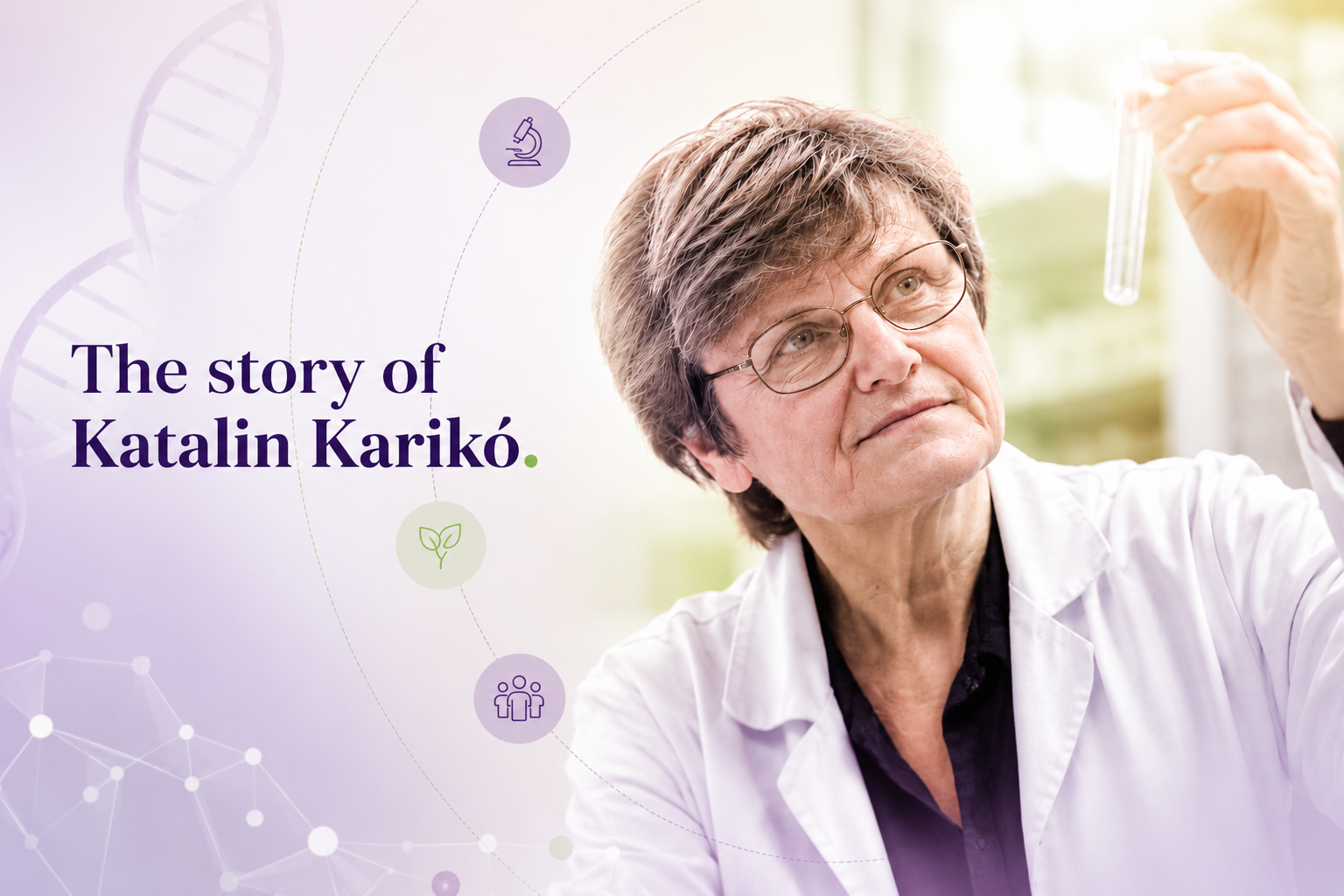
The story of Katalin Karikó illustrates how transformative scientific talent often becomes visible long after its value has emerged
Throughout the history of science, some of the most important discoveries have originated from individuals whose potential, expertise and vision were recognised only gradually. Their contributions frequently became apparent after years of persistence, experimentation and scientific conviction, often within environments where immediate commercial applications remained uncertain. While every scientific career follows a unique trajectory, these stories offer valuable lessons for organizations seeking to understand the relationship between talent identification, innovation and long-term value creation.
One of the most compelling contemporary examples is the career of Katalin Karikó. Born in Hungary and trained as a biochemist, Karikó dedicated much of her scientific career to the study of messenger RNA, commonly known as mRNA. During the 1980s and 1990s, interest in this field remained relatively limited compared with other areas of biomedical research. Funding opportunities were scarce, scientific skepticism remained widespread and many institutions questioned the practical potential of mRNA-based therapies. Throughout this period, Karikó continued pursuing research that she believed held significant promise despite the absence of widespread recognition and despite repeated professional setbacks.
Over time, her work contributed to a deeper understanding of how messenger RNA could be modified and used safely within the human body. These discoveries eventually became foundational elements of the mRNA technology platforms later employed by biotechnology companies such as BioNTech and Moderna. During the COVID-19 pandemic, these technologies enabled the rapid development of vaccines that reached hundreds of millions of people worldwide. In recognition of these contributions, Katalin Karikó and Drew Weissman were awarded the 2023 Nobel Prize in Physiology or Medicine. Nobel Prize – Katalin Karikó Facts
The relevance of this story extends beyond scientific achievement. It illustrates an important principle concerning the nature of expertise and value creation. The characteristics that ultimately made Karikó's work transformative were already present long before the broader market fully appreciated their significance. Scientific depth, intellectual perseverance, curiosity, problem-solving capability and commitment to a long-term vision existed throughout her career. The eventual impact emerged when scientific, technological and societal conditions converged to reveal the value of capabilities that had been developing for decades.
For biotechnology, pharmaceutical and chemical companies, this example offers an important perspective on talent. Future contributors rarely announce themselves through future achievements. Organizations evaluate individuals using information available in the present, while future impact remains inherently uncertain. As a result, recruitment and talent decisions increasingly require the ability to recognize indicators of future.
Competitive advantage increasingly depends on an organization's ability to recognize scientific value early
The story of Katalin Karikó highlights a reality that extends far beyond scientific research and resonates strongly within modern biotechnology, pharmaceutical and chemical organizations. Scientific potential, leadership capability and future contribution rarely become visible through a single credential, job title or career milestone. Their value emerges through a combination of expertise, context, judgment, learning capacity and the ability to generate meaningful outcomes within evolving environments. Consequently, one of the most important talent challenges facing organizations today concerns the ability to distinguish future contribution from historical experience.
For many years, recruitment processes across industries relied heavily upon indicators that were both accessible and relatively easy to compare. Academic credentials, years of experience, employer reputation, technical specializations and professional titles provided a structured framework for evaluating candidates. These criteria continue to offer useful information and remain important components of any assessment process. At the same time, the increasing complexity of scientific environments is encouraging many organizations to explore broader approaches capable of providing greater visibility into a candidate's likely contribution within future operating models.
This evolution reflects a broader transformation in the way value is created across the life sciences sector. Scientific progress increasingly occurs at the intersection of disciplines. Biotechnology converges with artificial intelligence. Manufacturing integrates advanced analytics and automation. Quality systems evolve through digital technologies. Regulatory environments require increasingly sophisticated coordination between scientific, operational and strategic functions. Within this context, organizations seek professionals capable of navigating complexity, connecting expertise across domains and contributing to environments that continue to evolve throughout their careers.
LinkedIn's Future of Recruiting research highlights the growing importance of skills-based evaluation and talent intelligence, reflecting a broader movement toward understanding capabilities in a more comprehensive manner. Organizations increasingly seek visibility into how candidates solve problems, influence stakeholders, adapt to change and contribute to business outcomes rather than focusing exclusively on traditional indicators of suitability. LinkedIn Future of Recruiting
The distinction between talent acquisition and talent identification becomes particularly important within highly specialized scientific environments. Talent acquisition focuses primarily on attracting candidates. Talent identification focuses on understanding which individuals possess the expertise, capabilities and potential most aligned with future organizational priorities. While both dimensions remain important, the second increasingly influences the quality of hiring decisions and the long-term value generated by those decisions.
Several characteristics distinguish organizations that consistently identify high-value scientific talent:
- They evaluate contribution as carefully as experience.
- They examine context alongside credentials.
- They seek evidence of problem-solving rather than relying exclusively on responsibility descriptions.
- They analyse the complexity of environments in which expertise was developed.
- They assess transferability across scientific, regulatory and operational settings.
- They consider future capability alongside past achievement.
These organizations recognize that scientific careers rarely evolve in a linear fashion. Some professionals develop expertise through highly specialized technical pathways. Others gain experience across multiple disciplines. Some emerge as scientific authorities. Others become influential leaders capable of connecting research, quality, operations and business strategy. The ability to recognise value across these diverse trajectories increasingly represents a competitive advantage.
This shift is gradually giving rise to a more evidence-based approach to scientific recruitment. Rather than concentrating primarily on visible indicators, organizations seek deeper visibility into the signals that predict future performance, future contribution and future leadership potential. As life sciences companies continue investing in innovation, digital transformation and scientific advancement, this capability is becoming increasingly relevant to long-term success.
The question therefore becomes increasingly practical: how can organizations systematically identify these signals within complex scientific talent markets and translate them into better hiring decisions?
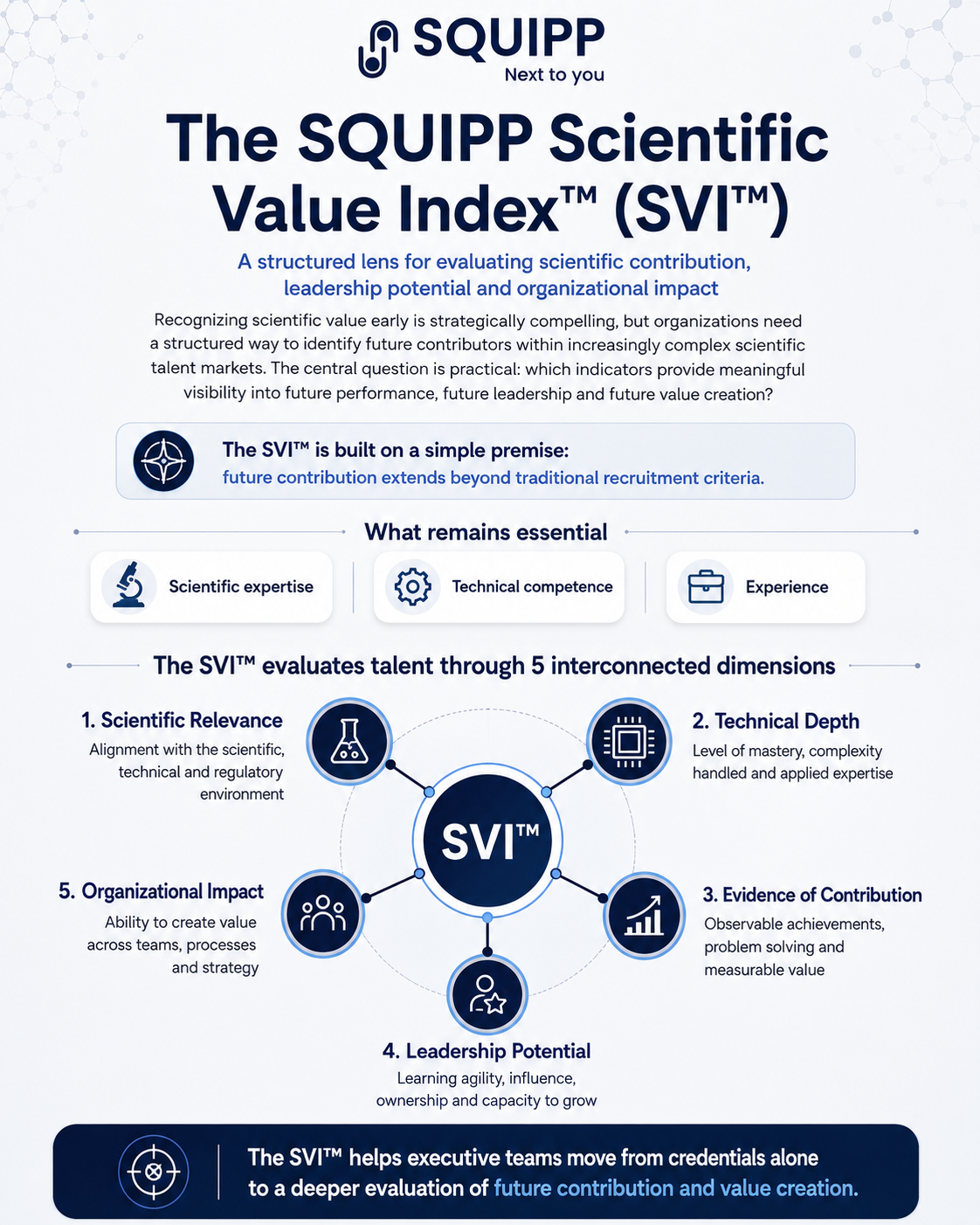
The SQUIPP Scientific Value Index™ (SVI™): a structured lens for evaluating scientific contribution, leadership potential and organizational impact
Recognizing scientific value early is strategically compelling, but for executive teams the challenge rapidly becomes operational. Organizations need a structured way to identify future contributors within increasingly complex scientific talent markets, where strong candidates may present similar qualifications while offering very different levels of future impact. The central question is therefore practical: which indicators provide meaningful visibility into future performance, future leadership and future value creation? This question led SQUIPP to develop the Scientific Value Index™ (SVI™), a structured evaluation framework designed specifically for biotechnology, pharmaceutical and chemical recruitment.
The SVI™ is built upon a simple premise: future contribution is influenced by factors that extend beyond traditional recruitment criteria.
Scientific expertise remains essential, technical competence remains essential, experience remains essential.
At the same time, organizations increasingly require visibility into the dimensions that determine how expertise translates into value creation.
The SVI™ therefore evaluates talent through five interconnected dimensions:
- Scientific Relevance examines the degree of alignment between a candidate's expertise and the scientific, technological and regulatory environment of the client organization. Experience acquired within advanced therapies, biologics manufacturing, quality systems, specialty chemicals, analytical sciences or regulatory affairs often carries context-specific value that significantly influences future performance.
- Complexity Exposure examines the scale and sophistication of the environments in which expertise was developed. Scientific professionals operating within global programs, highly regulated environments, advanced manufacturing operations or complex development activities often acquire capabilities that extend beyond technical knowledge alone.
- Evidence of Contribution focuses on measurable outcomes rather than responsibilities. Process improvements, regulatory achievements, quality enhancements, successful submissions, scientific innovations and operational transformations provide valuable insights into the relationship between expertise and value creation.
- Transferability evaluates the extent to which expertise developed in one environment can generate value within another. This dimension has become increasingly important as organizations seek talent capable of supporting transformation initiatives, technological evolution and cross-functional collaboration.
- Future Potential explores characteristics such as learning agility, leadership capability, intellectual curiosity and adaptability. These capabilities increasingly influence long-term performance as scientific and technological change continues to accelerate across the life sciences sector.
Collectively, these dimensions provide a more comprehensive understanding of scientific talent than traditional recruitment indicators alone. They also create a framework capable of supporting more informed hiring decisions within environments where expertise, innovation and execution are closely interconnected.
For biotechnology, pharmaceutical and chemical companies, the implications are significant. Organizations capable of evaluating talent through a broader strategic lens gain access to a wider range of potential contributors. They improve their ability to identify emerging leaders. They strengthen succession planning. They increase resilience. They create stronger foundations for innovation. Most importantly, they improve their capacity to align talent decisions with long-term business objectives.
As Europe's life sciences ecosystem continues to evolve, this capability is becoming increasingly valuable. Scientific talent is not distributed evenly throughout the market. Expertise often develops within highly specialized environments. Future contributors frequently remain invisible to traditional recruitment processes until their value becomes widely recognised. Organizations capable of identifying this value earlier gain access to opportunities unavailable to competitors relying exclusively on conventional approaches.
The future competitiveness of Europe's biotechnology, pharmaceutical and chemical sectors will depend upon scientific innovation, technological leadership and industrial excellence. Each of these pillars ultimately depends upon people. The organizations that consistently identify, attract and develop high-value talent will be better positioned to translate scientific potential into commercial success, operational performance and sustainable growth.
Organizations that identify scientific potential early gain access to a broader and more differentiated talent ecosystem
One of the most significant advantages created by evidence-based talent identification concerns access to expertise that remains largely invisible to conventional recruitment processes. As biotechnology, pharmaceutical and chemical industries become increasingly specialized, the professionals capable of generating the greatest value frequently become less visible through traditional hiring channels. Many remain deeply engaged within their current organizations, contributing to strategic development programs, supporting complex regulatory initiatives, leading manufacturing transformations, strengthening quality systems or driving scientific innovation. Their expertise exists within the market, yet their visibility remains limited.
This reality is particularly relevant across the European life sciences sector, where critical expertise often develops over many years through exposure to highly regulated environments, complex technologies and multidisciplinary challenges. The strongest candidates rarely originate from a single talent pool. They may emerge from biotechnology companies, pharmaceutical manufacturers, specialty chemical organizations, contract development and manufacturing organizations, research institutes or adjacent industries facing similar technological transformations. As scientific disciplines increasingly converge, some of the most valuable expertise emerges at the intersection of multiple domains.
Organizations capable of identifying scientific potential early gain access to a broader and more differentiated talent ecosystem. Rather than competing exclusively for the same visible candidates, they develop visibility into adjacent talent pools, transferable expertise and emerging leaders whose value may not yet be fully recognized by the wider market. This capability strengthens succession planning, improves workforce resilience and increases the probability of identifying individuals capable of supporting future strategic priorities.
The strategic implications extend far beyond recruitment itself. Visibility into scientific talent enables organizations to anticipate capability requirements before they become urgent, strengthen leadership pipelines before critical gaps appear and align workforce decisions more closely with long-term business objectives. Rather than reacting to talent shortages, organizations gain the ability to proactively build the expertise required to support innovation, operational excellence and future growth.
As Europe's life sciences ecosystem continues to evolve, this capability is becoming increasingly valuable. Scientific talent is not distributed evenly across the market. Expertise develops within highly specialized environments and often remains difficult to identify using conventional recruitment approaches alone. Organizations capable of recognizing value earlier gain access to opportunities that remain unavailable to competitors relying exclusively on traditional talent acquisition practices.
As biotechnology, pharmaceutical and chemical organizations prepare for the next decade of life sciences development, scientific talent strategy is becoming one of the strongest determinants of execution capacity. Europe’s ambitions in life sciences will take shape through organizations able to translate scientific opportunity into industrial performance, regulatory success, manufacturing reliability, quality excellence and technological progress. This transformation will require access to professionals capable of operating across increasingly complex scientific, operational and regulatory environments, where expertise, judgment, adaptability and leadership capacity directly influence the ability of companies to grow.
This creates a strategic responsibility for executive teams. Companies need to anticipate the capabilities their future will require, identify where these capabilities are emerging in the market and build earlier access to the professionals whose expertise can support future priorities. Recruitment decisions therefore become connected to product development, industrial scale-up, lifecycle management, inspection readiness, digital transformation, sustainability objectives and leadership succession. The organizations that structure this capability early gain a stronger position in increasingly competitive scientific talent markets.
A more evidence-based approach to talent identification provides the discipline required to support this evolution. By assessing scientific relevance, complexity exposure, evidence of contribution, transferability and future potential, companies gain greater visibility into how expertise has been developed, how it has generated value and how it can support the next stage of organizational growth. This perspective strengthens the quality of hiring decisions and helps leadership teams align talent with the scientific, operational and strategic requirements that will shape future performance.
SQUIPP supports biotechnology, pharmaceutical and chemical companies in this transition by combining sector understanding, market intelligence and a structured evaluation methodology designed for scientific recruitment. The objective is to help organizations identify, attract and secure professionals able to contribute meaningfully to innovation, operational excellence, regulatory performance and long-term competitiveness. In a market where scientific expertise becomes increasingly specialized and competition for high-value profiles continues to intensify, the companies that act early will secure a decisive advantage: access to the talent capable of shaping their future growth.
Why is talent strategy becoming critical in Europe’s life sciences sector?
Talent strategy is becoming critical because biotechnology, pharmaceutical and chemical companies increasingly depend on specialized scientific expertise to drive innovation, regulatory performance, operational excellence and long-term competitiveness.
Why is scientific recruitment becoming more complex?
Scientific recruitment is becoming more complex because companies now need profiles that combine scientific depth, digital literacy, regulatory understanding, leadership capability and business awareness.
What types of profiles are becoming strategic for biotech, pharma and chemical companies?
Strategic profiles include QA leaders, Regulatory Affairs and CMC experts, process development specialists, analytical development professionals, QC experts, senior chemists, formulation scientists and digital quality profiles.
Why are the best scientific candidates often difficult to identify?
The best scientific candidates are often difficult to identify because many of them are not actively looking for a new position and their value may be hidden within highly specialized, interdisciplinary or emerging scientific environments.
What does the story of Katalin Karikó teach about scientific talent?
The story of Katalin Karikó shows that transformative scientific talent can remain underestimated for years before its value becomes widely recognized. It highlights the importance of detecting scientific potential early.
How can companies improve scientific talent identification?
Companies can improve scientific talent identification by using a structured, evidence-based approach that evaluates scientific relevance, complexity exposure, evidence of contribution, transferability and future potential.