
You are closer than you think: how to read job offers without disqualifying yourself too early?
The psychology of self-disqualification
There is a decisive moment in your job search process where a role initially appears aligned with your background, as responsibilities reflect familiar tasks, the environment corresponds to your previous exposure and the level of responsibility supports a coherent career progression within pharmaceuticals, biotechnology and chemical industries. This first reading creates a structured perception of continuity between your existing expertise and your potential future contribution, which forms the basis for evaluating your professional relevance.
As you move toward the requirements section, the structure of the description introduces detailed expectations related to years of experience, regulatory exposure, technical systems and operational environments, which progressively shifts your interpretation of the role. You may transition into a granular evaluation method, analysing each requirement individually and comparing it directly with your background, which redirects your attention toward alignment at a micro level instead of assessing your capacity to perform the responsibilities associated with the position.
This reading pattern influences your decision-making by introducing a form of self-assessment focused on eligibility, where you evaluate your legitimacy to apply based on textual correspondence with listed criteria.
Research published by Harvard Business Review highlights that professionals frequently exclude themselves from opportunities due to an overly rigid interpretation of job descriptions, even when their experience supports the core responsibilities of the role (https://hbr.org/2022/07/apply-to-a-job-even-if-you-dont-meet-all-criteria).
Common reading patterns that limit opportunities
A frequent pattern in job description analysis involves focusing on specific requirements that appear absent from your background, which shifts your attention away from relevant experience and reduces visibility on capabilities that support your performance. This approach creates a narrow interpretation of the role, where contextual elements receive the same level of importance as core responsibilities.
Another pattern involves analysing descriptions through a line-by-line comparison method, which introduces a detailed evaluation of alignment without considering the broader operational scope of the position. This reading strategy limits your ability to identify how your existing experience supports decision-making, coordination and execution within the role.
A structured interpretation supports a balanced evaluation of requirements, where you maintain focus on your capacity to contribute through core competencies while recognising that certain contextual elements are integrated through onboarding and operational exposure within the organisation.
Are job descriptions more demanding than they actually are?
Job descriptions in regulated industries reflect environments where precision, compliance and risk management define operational frameworks, which leads to a high level of detail in how expectations are formulated. These documents are developed through contributions from multiple stakeholders, including hiring managers, regulatory specialists, quality functions and talent acquisition teams, each introducing specific requirements linked to performance, onboarding and internal processes.
This collaborative construction results in layered descriptions that accumulate technical, operational and contextual elements over time, presenting a comprehensive profile that integrates immediate performance expectations with additional capabilities that support long-term effectiveness. The structure often reflects an ideal candidate profile that consolidates multiple dimensions of expertise without distinguishing the relative operational weight of each requirement in day-to-day activities.
Insights from McKinsey & Company indicate that organisations are progressively evolving toward skills-based hiring models, where the evaluation of candidates focuses on capabilities and adaptability within the role rather than strict alignment with predefined criteria, reinforcing the importance of interpreting job descriptions through a functional lens (https://www.mckinsey.com/capabilities/people-and-organizational-performance/our-insights/right-skills-right-person-right-role).
Reading job descriptions with professional judgement

A structured reading approach involves identifying the core responsibilities that define the position, including decision-making, regulatory accountability, technical ownership and cross-functional coordination. These elements represent the functional core of the role and provide a reliable framework for a complete review of your professional alignment based on your experience, problem-solving exposure and your ability to work within structured environments.
You benefit from assessing how your background supports these dimensions through previous responsibilities that required analytical reasoning, stakeholder interaction and execution within regulated frameworks. This method allows you to evaluate your relevance beyond specific tools, regions or systems, with a clear focus on your capacity to contribute effectively within the role.
An additional step in your analysis involves distinguishing between skills required for immediate contribution and those developed through structured onboarding. Many roles include a progression phase during the first months, which supports a realistic positioning of your experience, where your existing capabilities form a solid foundation and additional skills are integrated through learning within the role.
Positioning transferable skills across contexts
Transferable skills represent consistent professional capabilities that apply across roles, products and regulatory environments, reflecting how you analyse complex information, structure decisions and execute tasks within defined processes. In pharmaceuticals, biotechnology and chemical industries, these skills include data interpretation, technical writing, regulatory knowledge, stakeholder coordination and problem-solving within constrained environments.
These capabilities maintain their relevance across different contexts, enabling you to apply your experience within new regulatory frameworks, systems or product categories while maintaining performance standards. Research from World Economic Forum and LinkedIn highlights the increasing importance of adaptability and continuous learning in evolving labour markets, reinforcing the value of positioning transferable skills as a central component of your professional identity (https://www.weforum.org/reports/the-future-of-jobs-report-2025).
A precise articulation of these skills enables employers to understand the continuity between your past experience and your future contribution, supporting a direct evaluation of how you integrate into the role and deliver value within a structured environment.
How SQUIPP aligns your profile with market expectations
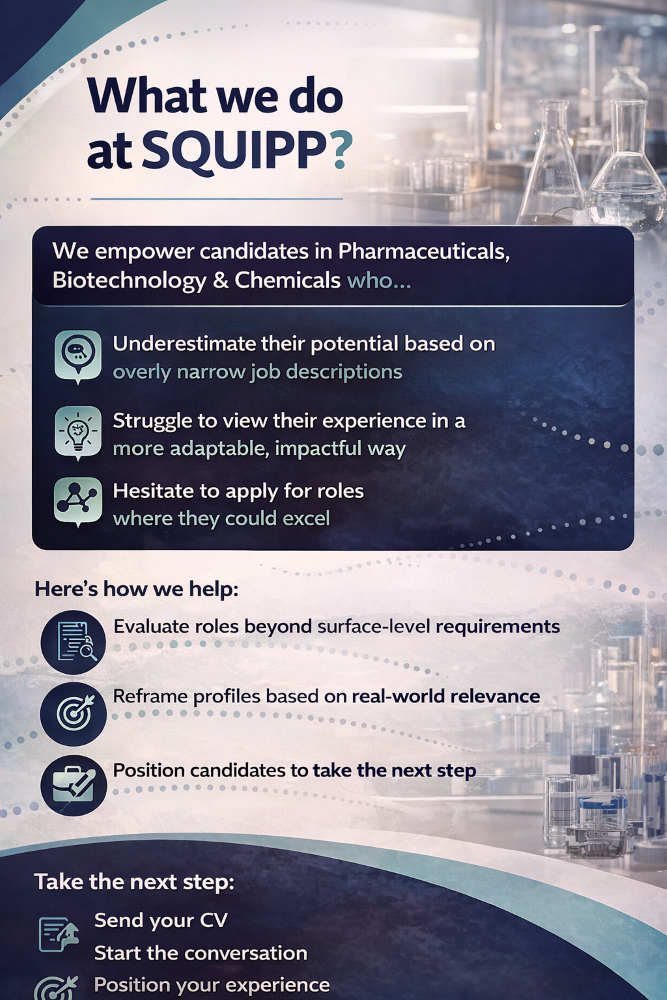
SQUIPP supports you by analysing both the job description and your background through a functional approach, identifying what drives performance in the role and translating your experience into operational relevance. This approach enables you to position your profile based on your ability to operate within the responsibilities associated with the position.
The process involves structuring your application around core responsibilities, clearly articulating your transferable skills and aligning your experience with the expectations of employers in regulated environments. This approach strengthens the clarity of your application and helps employers understand how you contribute to organisational objectives.
Breaking down job descriptions helps you clearly understand how your experience fits the role and supports better application decisions. By comparing your skills with the key responsibilities, you can present yourself more effectively in competitive and regulated environments.
Why do candidates disqualify themselves too early?
Because they apply a line-by-line comparison instead of evaluating their ability to perform the role. This creates a narrow interpretation focused on gaps rather than strengths.
How can I identify the most important requirements?
Focus on:
• decision-making responsibilities
• regulatory or technical ownership
• cross-functional interactions
• impact on operations
These elements define performance in the role, not secondary tools or specific systems.
What are transferable skills in regulated industries?
They are capabilities that remain relevant across contexts, such as:
• analytical reasoning
• technical writing
• regulatory understanding
• stakeholder coordination
• problem-solving in structured environments
These skills allow you to adapt quickly to new roles or environments.
How should I read a job description more effectively?
Adopt a functional reading approach:
• identify what the role is designed to achieve
• assess how your experience supports these outcomes
• distinguish between immediate requirements and learnable elements
Should I apply if I don’t meet all the requirements?
Yes. Most job descriptions describe an ideal profile, not a minimum threshold. If your experience aligns with the core responsibilities and you can operate effectively in the role, your application is relevant.
What do employers really assess during recruitment?
What do employers really assess during recruitment?
Increasingly, employers focus on:
• your ability to perform in the role
• your learning capacity
• your adaptability within structured environments
Not just strict alignment with every listed requirement.