
Evaluating recruitment agencies for biotech, pharma & chemical hiring
Key indicators to identify a high-performing recruitment partner

You have a vacancy to fill, a technical profile, rare, critical to your operations, and across the table you have recruitment agencies that all sound remarkably alike in their sales pitch, each one promising speed, quality, and deep sector expertise with equal confidence and equal vagueness. The real question, the one that will determine whether you spend the next six weeks making real progress or simply going in circles, is deceptively simple: how do you tell apart the agency that will actually find you the right candidate from the one that will waste your time, flood your inbox with irrelevant CVs, and quietly disappear when the search stalls?
Most managers choose an agency based on reputation, price, or an internal recommendation passed along through a colleague's LinkedIn post or a brief conversation at a conference. Reputation and word of mouth are reasonable starting points that serve well in many professional contexts, though recruiting a rare technical profile in a regulated sector rewards a more deliberate and structured evaluation than an informal recommendation can reliably provide. Recruiting a technical profile in a regulated sector is a fundamentally different exercise from finding a sales manager or a generalist CFO, and the evaluation criteria need to reflect that difference in full. The candidate pool is narrower, the stakes are higher, and the cost of a bad hire, measured in time lost, team disruption, and regulatory risk, is considerably more severe than most managers account for before it happens to them.
This guide is designed to give you the right questions to ask, the signals to watch for, and the mistakes to avoid before you sign anything. It is written for operational managers, the people who live with the vacancy every day, who understand the job from the inside, and who will be the first to feel the consequences if the hire goes wrong.
Sector specialisation, the decisive filter
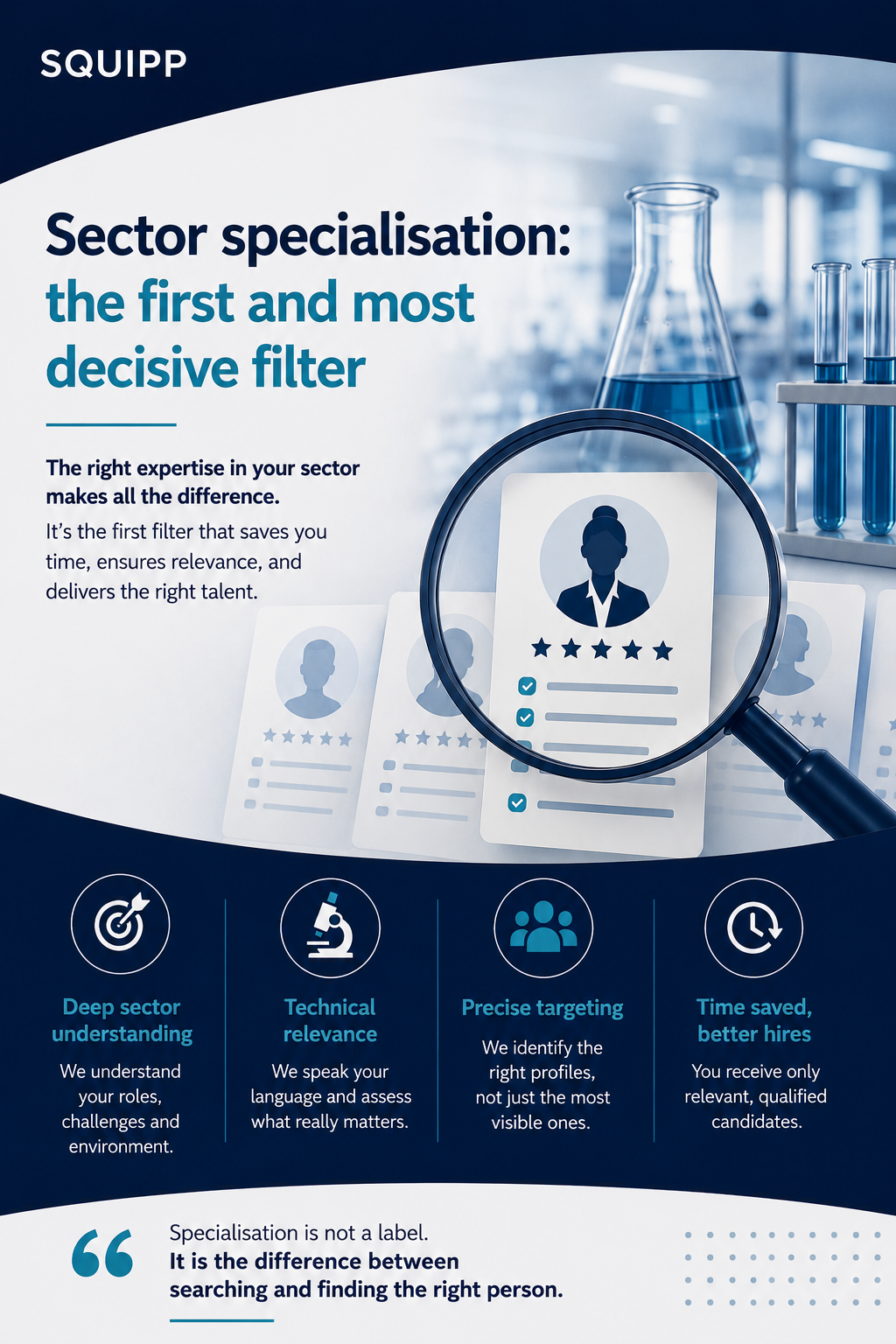
The first and most decisive question to ask is whether the agency actually understands your sector in the working detail of the job you need to fill. A recruiter who cannot tell the difference between a QA Manager and a Regulatory Affairs Manager, or who confuses CMC with manufacturing process, will forward profiles that look plausible on the surface without understanding why certain combinations of experience are disqualifying, and you will only discover this after spending several hours reading CVs that should never have reached you.
The most effective way to test this is to ask a technical question about the specific role. For a QC position in biotech, ask what distinction the agency makes between an analytically validated method per ICH Q2 and a qualified method for release testing. For a Regulatory CMC role, ask how they assess a candidate's experience with post-approval variations and what level of hands-on file ownership they look for. For an R&D position in industrial chemistry, ask whether they understand the difference between a batch and a continuous process, and what that implies for the candidate profile you should be targeting. The answer does not need to be technically perfect.
What you are observing is if the recruiter listens carefully, reformulates thoughtfully, and asks to go deeper into your specific context, or whether they fall back on a generic response about their extensive experience in the life sciences space.
A recruiter embedded in the sector will say: "I do not have full command of that specific point, but here is how I plan to get up to speed before we start."
Someone operating at a generalist level will say: "No problem, we are used to recruiting in your industry.'"
Learning to distinguish between those two responses early on will save you a great deal of time.
It is also worth noting that specialisation in pharmaceutical recruitment does not automatically translate to relevance in industrial chemistry, food manufacturing, or even all segments of biotech. The candidate pools differ, the collective agreements differ, the compensation benchmarks differ, and the quality culture has distinct characteristics in each domain. The question to ask is whether the agency's specialisation matches your sector and your type of role precisely, and that answer should come from evidence instead of from how they describe themselves.
The candidate pool and the reality of the network
Every recruitment agency you speak to will tell you about their database. They will mention the number of profiles it contains, the years it has been built up, the sophisticated search tools they use to mine it. That does not really matters, especially when you are looking for a rare technical profile in a regulated sector. What matters is the quality of their active network: the candidates the recruiter knows by name, has had substantive conversations with in the past twelve months, and can call tomorrow morning without having to explain who they are or what they are looking for.
A CV database stores information passively and retrieves it on request, with no memory of the conversations, the context, or the people behind the profiles. A real network is something meaningfully different: a web of relationships maintained over time through regular contact, professional interest, and the kind of informal exchanges that only happen when a recruiter is actually embedded in a sector and known within it. In regulated technical fields, the best profiles do not apply to job postings. They are employed, performing well, and have no particular urgency to move, and they will only consider a new opportunity if it is presented well, by someone they trust, at the right moment. A recruiter with the right network knows those candidates by name, they know what those candidates are looking for, what made them leave their last role, how they think about career progression, and how to frame your opportunity so that it lands with the right weight.
When evaluating an agency's network, three questions will give you the clearest signal.
- First: how many active candidates can they count on in the exact perimeter of your role, the right geography, the right specialisation, the right level of seniority?
- Second: do they have profiles on standby that they have already met in person for this type of position, and can they describe the general profile of two or three of them without revealing names?
- Third: what is their average time between launching a search and presenting their first qualified candidates in this sector specifically?
A turnaround of ten to fifteen days for first presentations is a strong indicator of a real, active network, if initial feedback takes more than three weeks, you are most likely dealing with an agency starting the sourcing process from scratch, which is not necessarily fatal, but is something you deserve to know upfront rather than discover halfway through a search you were counting on.
An agency with a strong active network will naturally say something like:
"Actually, I have two profiles in mind that I met a few months ago on a similar search, I will reach out to them straight away."
If at no point in the first meeting any candidate is mentioned by type or profile, that silence is itself a signal worth noting.
Performance indicators to request before you sign
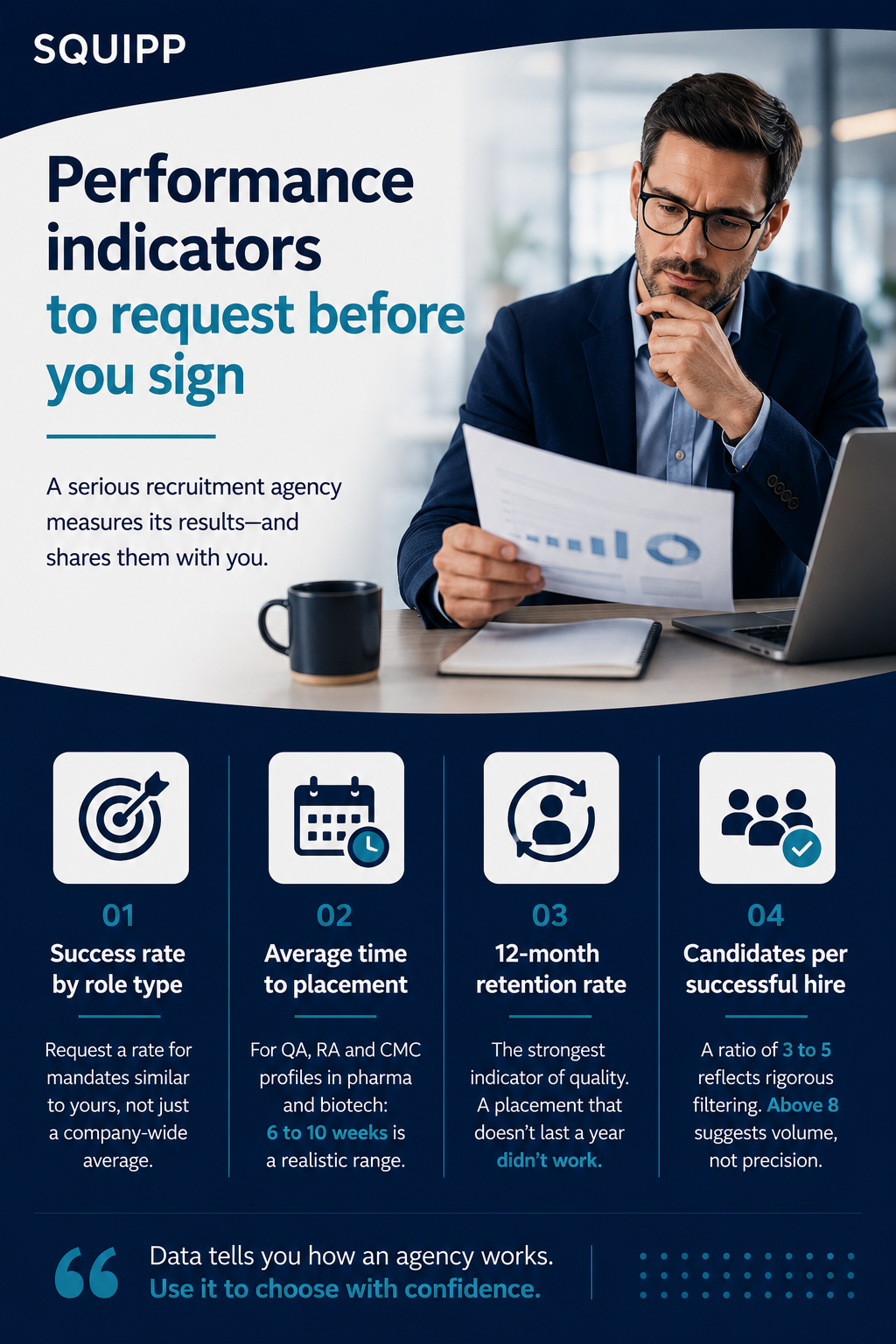
A serious recruitment agency measures its results systematically and shares those figures with prospective clients. Reluctance to provide performance data reflects either the absence of systematic tracking or results that do not hold up well to scrutiny, and in either case the information is relevant to your decision before you commit to anything.
Four metrics are worth requesting specifically.
- The first is success rate by role type, meaning a rate tied to mandates similar to yours rather than a general company-wide figure, because an agency can perform very well on commercial positions while delivering much weaker results on regulated technical profiles, and the aggregate number will obscure that entirely.
- The second is average time to placement: for QA, RA, and CMC profiles in pharma and biotech, a realistic timeline from search launch to offer acceptance runs between six and ten weeks, and significant deviation from that range in either direction deserves a direct conversation.
- The third is the twelve-month retention rate, which is the most meaningful quality indicator of all and the one agencies are least likely to raise unprompted, since a placement that does not last a year is a placement that did not work.
- The fourth is the number of candidates presented per successful hire, where a ratio of three to five signals rigorous filtering, and a ratio above eight suggests the agency is sending volume and expecting you to do the selection work yourself.
Can a young recruitment agency truly recruit effectively?
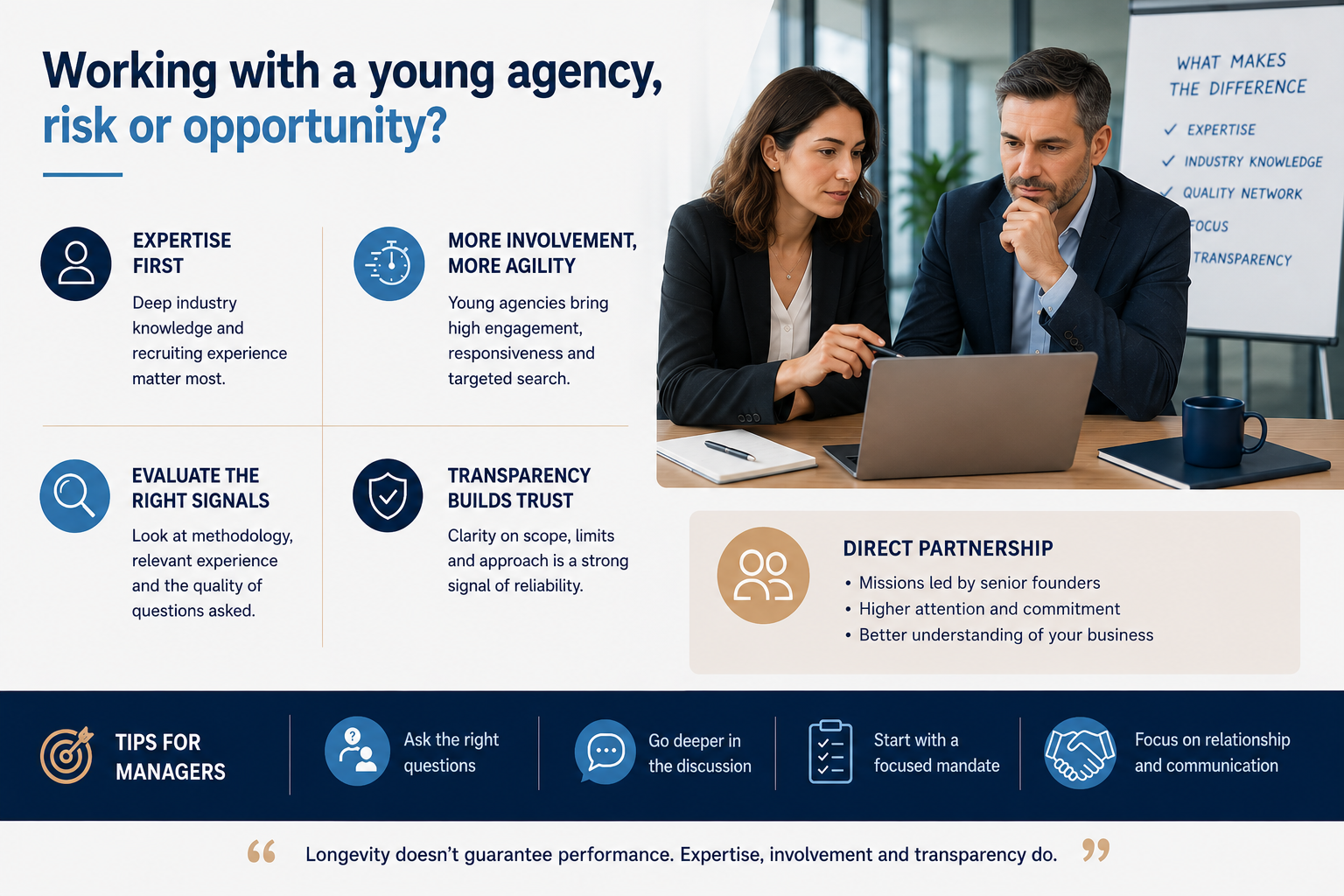
A recent agency should not automatically be perceived as a risk or as a less relevant partner than a structure established for many years. In technical and regulated sectors, the quality of a recruitment process rarely depends solely on the commercial longevity of a company. It depends above all on the real expertise of the people conducting the search, their understanding of the role, their ability to assess a profile accurately, and the quality of the network they have built throughout their professional careers.
A young agency can sometimes bring a higher level of involvement, greater responsiveness, and a much more targeted approach than a larger structure operating through standardized processes. When a company does not yet have several years of consolidated performance indicators, the evaluation should shift toward other signals of credibility. It becomes relevant to assess the operational experience of the recruiters themselves, their concrete knowledge of the sector, their ability to quickly understand the technical challenges of the position, the quality of the questions they ask during discussions, and the rigor of their qualification methodology.
It is also useful to observe the agency’s transparency regarding its level of maturity. A serious young structure will clearly explain what it already masters, the types of profiles for which it is relevant, the possible limits of its current scope, and how it secures its searches despite having a more recent track record. This operational honesty is often a more reliable signal than a highly formatted commercial pitch.
Finally, working with a young agency can also allow for a more direct level of partnership. In many small specialized structures, assignments are still managed by the founders themselves, with a level of attention, commitment, and business understanding that is often difficult to find in larger organizations where mandates can become highly industrialized.
What the working relationship should look like from the start
Recruiting a technical profile in a regulated sector is a short but intense partnership that requires real communication and honest exchange from the very first conversation. The quality of the working relationship you establish in the first two weeks will shape almost everything that follows.
A recruiter running an active search should be contacting you proactively and with substance, updating you on progress, describing profiles they have spoken with, flagging difficulties or market signals they have encountered along the way. If you find yourself chasing them for news about your own vacancy in the first weeks, that pattern reflects how they manage client relationships in general and will not improve over time. Test the responsiveness early, because how a recruiter handles the initial stages of contact is a reliable indicator of how they will handle the search.
One of the most useful qualities to look for in a recruitment partner is the willingness to tell you when something in your brief is working against you. If the profile you are looking for is too rare in the current market, if the compensation is below the benchmark for that level of experience, or if the working conditions are structurally unattractive for the target audience, a recruiter who understands the market will say so clearly and with evidence, early in the process. An agency that confirms everything you say without qualification and later delivers weak results has, in most cases, prioritised keeping the mandate over being useful to you from the start.
A technical role is also never simply a list of competencies to match against a shortlist of candidates. There is a manager behind the role, a team dynamic, a company culture at a particular stage of development, and a set of expectations that no job description will ever fully capture. A recruiter who does not actively try to understand those elements will present technically sound profiles that are culturally or interpersonally misaligned, and that misalignment tends to become visible within the first six months in ways that are both costly and avoidable.
Pay attention to whether they ask about your management style, about what has made previous integrations succeed or fail, and about the current state of the team the new person will be joining.
Recognising the right agency

A recruitment agency specialised in regulated technical sectors distinguishes itself on five verifiable dimensions.
- It demonstrates sector knowledge that holds up under direct technical questioning.
- It has access to a candidate network built through sustained relationships over time.
- It applies a qualification process that is rigorous, documented, and transparent.
- It tracks performance across meaningful indicators, including time to placement, success rate by role type, and twelve-month retention, and shares those figures openly when asked.
- And it operates as a partner that challenges your brief when the market requires it and works alongside you rather than simply processing your vacancy.
The agency worth working with understands your profession from the inside, works with rigour at every stage of the process, and has the network to reach profiles you would not find on your own. That combination is rarer than the sales pitches suggest, but it exists, and it is worth the time to identify properly before you hand over a vacancy that your operations are counting on. A few hours of careful evaluation at the outset will save you weeks of wasted effort, a prolonged open position, and very possibly a hiring decision you will come to regret.
Take the evaluation seriously before you commit. The agencies that will waste your time and the agencies that will find you the right person often sound identical in a first meeting, and the difference only becomes clear once the search is underway and it is too late to change course without losing weeks. A few hours spent asking the right questions upfront is the most efficient investment you can make before handing over a vacancy that your team and your operations are genuinely counting on.
What is the difference between a generalist agency and a specialist pharma recruiter?
A generalist agency recruits across all types of roles and sectors and typically has a solid methodology, but does not maintain an active network in the regulated or technical functions specific to pharma, biotech or chemistry. A specialist agency knows the professional frameworks that govern the sector, understands the key players and career paths within it, and maintains a candidate pool built through sustained, sector-specific engagement over time.
How much does a specialist recruitment agency cost?
Agency fees typically range from fifteen to twenty-five percent of the hired candidate's gross annual salary, depending on the seniority of the role, the scarcity of the profile, and the scope of services included. Some agencies charge a fixed retainer paid in stages, while others work on a pure success-fee basis. The relevant measure is the relationship between what you pay and the quality of the hire you receive, assessed by whether that person is still in the role and performing well twelve months later.
How can I tell if an agency has a real network in my sector?
Ask them about roles and profiles they have filled recently in your sector, and whether they can describe, without naming anyone, two or three candidates they have spoken with in the past six months on similar mandates. An agency with a real network will answer with concrete, specific examples. One sourcing from scratch will respond with generalities about their database and methodology, which are real capabilities but are not substitutes for knowing the relevant candidates personally.
Should I work exclusively with one agency?
Exclusivity gives the recruiter reason to commit fully to the search, and that commitment tends to produce better results. Grant it only after confirming that the agency has an active network for the type of role in question. In pharma and chemicals, one month is a reasonable starting point, with a clearly negotiated exit clause that allows you to open the search to other partners if results are not materialising.
What guarantee should I request if the hire does not work out?
Most serious agencies offer a replacement guarantee if the candidate leaves within the first three to six months, either as a free replacement or partial reimbursement of fees. Read the conditions carefully before signing, since some guarantees apply only when the candidate resigned voluntarily or when the departure is attributable to factors within the agency's control. Ask specifically whether the guarantee covers situations where a qualification error on the agency's part becomes apparent after the hire.
What is the realistic timeline for hiring a technical profile in pharma or chemicals?
For a confirmed technical or regulatory profile at QA, RA, CMC, R&D, or HSE level, the timeline from search launch to offer acceptance realistically runs between six and ten weeks, covering sourcing, qualification interviews, client-side rounds, and negotiation. A process closing in under four weeks raises the question of whether qualification was given adequate time, while one extending beyond twelve weeks on a standard profile suggests either an exceptionally rare profile or insufficient network coverage.
How can I evaluate an agency quickly, in under an hour?
Three steps are sufficient. Start with their website and recent LinkedIn content, looking for material that demonstrates technical understanding of the roles they claim to specialise in. In the first call, ask a direct technical question about the specific role you need to fill and listen carefully to the response. Then ask for two recent client references in your sector and call them, since a five-minute conversation with a former client will tell you more than an hour of polished sales conversation with the agency itself.